

Maureen Friend is a social media specialist for American Mensa and the Mensa Foundation, where she creates content focused on lifelong learning, intellectual engagement, and topics of interest to curious minds.
“Can you tell me who in your family I saw today?” It’s an odd question, a HIPAA compliance screening question I’m used to but also one I was surprised to get.
Surprised because it occurred during my first conversation with my dad’s GP, who’d seen Dad that morning. Unsurprised because it’s the same question my husband answers each time I have a visit with Wisconsin Alzheimer’s Disease Research Center to track my brain health. WADRC calls him to ensure my account of recent visits matches his recollection.
I’ve been a WADRC Core Study participant for 10 years. So far, so good on the story matching.
Facing Reality and Accepting Help
I don’t know why I was approached to take part in the research study, probably because I was a new hire at the University of Wisconsin and got on a list. Joining the study is a great deal: Take a short quiz, do some longer number and word memory tasks, recount a recent past event, and repeat every two years. On alternate years, there’s a physical, some brain imaging, a lumbar puncture if you’re brave enough; all free. New this year, PET scans, the kind of imaging that shows those emerging TAU tangles and amyloid plaques. You get paid for those, too!
No tangles or plaques for me this year, but I admit this was the first time I considered whether knowing would be better or worse. That’s where my parents were when I stepped in to seek a diagnosis of Dad’s cognitive ability changes: not sure whether knowing was better than not knowing.
Dad spent his career as a pharmacist and research physiologist, his mind one of his defining strengths. At first, each incident seemed explainable on its own. Everyone forgets things. Everyone gets frustrated. Everyone misses part of a conversation now and then. But eventually the pattern became impossible to ignore. The hardest part wasn’t noticing the changes. It was accepting what those changes might mean. Looking back, the signs were becoming harder to ignore:
- Increasing reliance on Mom to explain and interpret what he didn’t follow in a conversation
- Holding an object, starting a task, and not being able to remember why he started or how to make the object work
- Agitation and distress when being driven in a familiar area, not the way he would have gone
- Defensiveness when questioned about competencies or offered help by anyone other than Mom
- Denial of hearing loss
- Increased use of alcohol
I stepped in because Mom was scared. She had tried encouraging him to simply schedule a med check. This was savvy — he had wondered aloud if maybe some of his meds were interacting in a less-than-helpful way. She had resisted taking control of his healthcare, instead relying on him to manage his own health, as he always has. We needed the right messenger, so I called his doctor and asked him to reach out for a med check.
That day, his doctor told him he had Alzheimer’s.
Dad hasn’t been willing to talk about it. He’s working toward acceptance. Accepting help isn’t a single decision. It happens in stages. It has meant admitting something has changed and allowing questions. Now it means allowing others to become part of the process.
Work and Life Connect
Watching my father navigate cognitive changes, and knowing that I may face my own, informs how I think about intelligence. Minds are not just tools for intelligent people. They are part of identity. Brains are their treasure, their joy, the basis of their working and creative life, sometimes a gift they share with a loved one, the thing they could count on since birth. Loss around that identity must be so painful.
I have tried to provide hopeful, helpful research findings and assistive technology reviews in my social media work for Mensa. Many signs point to advancements in research and treatment options, coming at an accelerating pace. Now Mensa membership includes access to evidence-based advice. Through our “better together” work with the Mensa Foundation, we’re helping spread the word about maintaining brain health, prevention instead of cure. It’s available to you and anyone interested in cognitive vitality.
I still don’t know whether my parents would say that knowing is better than not knowing, but I believe that understanding gives us options. It gave us language for what was happening and a chance to act. That’s why conversations about brain health matter for those experiencing cognitive changes today and for all of us who hope to preserve the abilities that make us who we are.
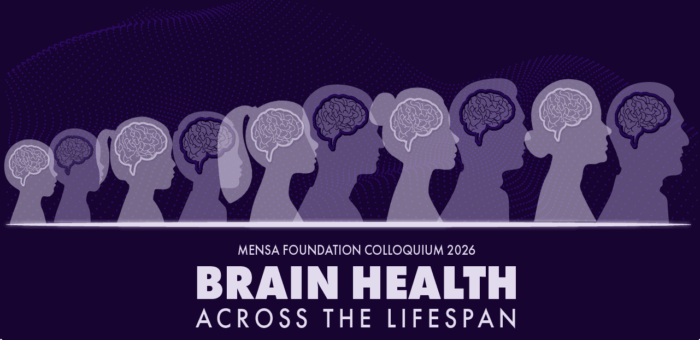
Brain Health Across the Lifespan
The Mensa Foundation Colloquium 2026 asks a practical question: What actually makes a brain healthy across a lifetime? The answer has many pieces: sleep, nutrition, laughter, emerging medical treatments, and ways of thinking about brain health that begin outside the brain itself. Brain health is not one thing, but many systems working together.
Join us in Fort Worth, Texas, at the Omni Hotel, or online from anywhere, for an afternoon built to send you home with both useful tools and a renewed sense of wonder about the most complex organ you own.
In-person registration is $149; the livestream is $49 and broadcasts live on June 30. A livestream-plus-recording option is also available for $99, with the recording delivered roughly a month after the event.
If this story resonates with you, join us for Brain Health Across the Lifespan on June 30.
Register today: mensafoundation.org/events/colloquium/





Comments (0)