
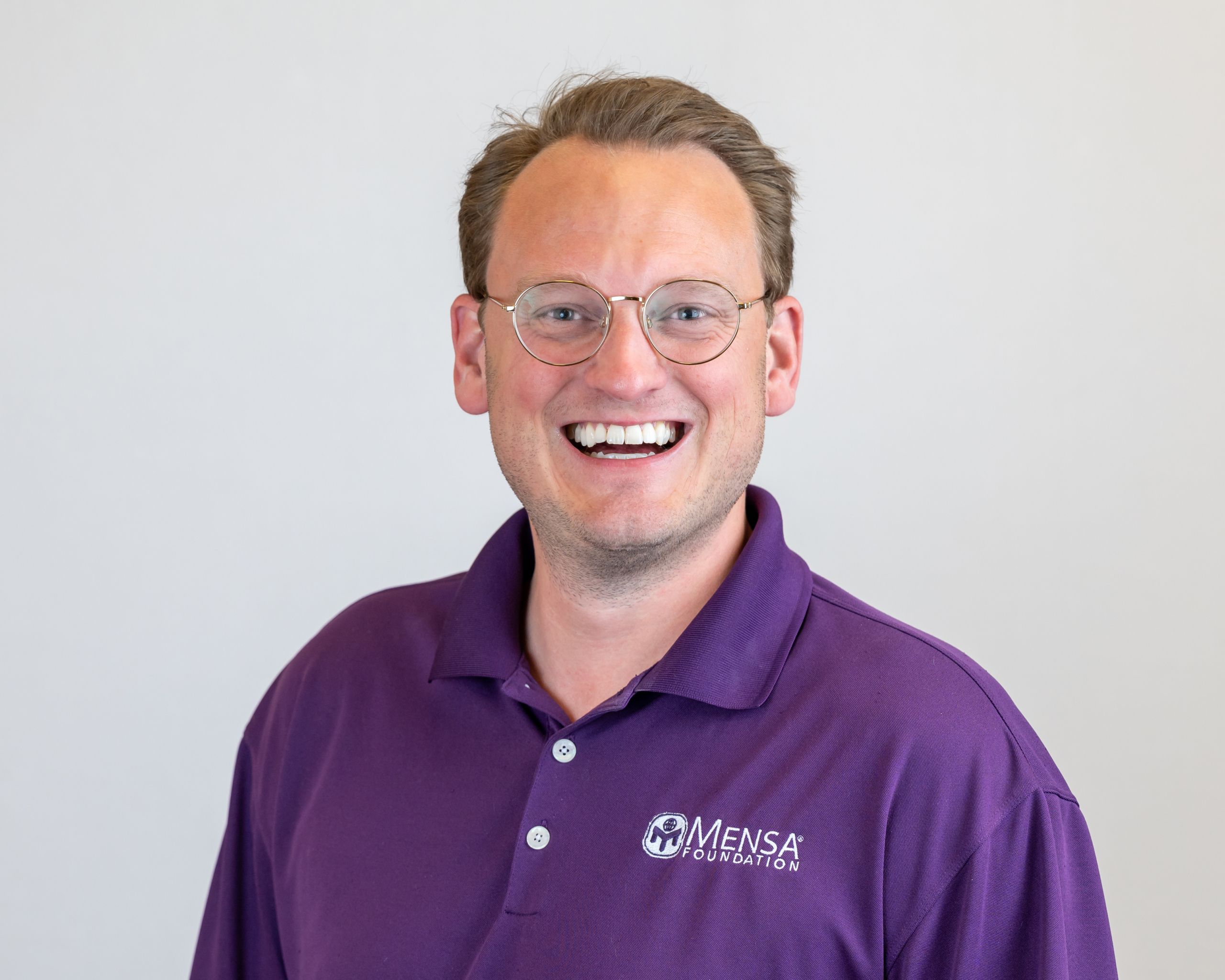
John is Director of Development and Impact at the Mensa Foundation, where he leads fundraising and programs that expand the understanding of intelligence and support gifted people across the lifespan.
The study of gifted adults is emerging as a distinct area within the broader field of gifted studies, and the Mensa Foundation is uniquely positioned to help lead it.
I have believed for years that the Foundation could help widen the field’s understanding of giftedness. Dublin did not teach me this. It confirmed it while also reminding me that leadership cannot mean exchanging one narrow frame for another. “Giftedness is for life” has become a guiding principle for the Foundation. If we mean it, our work must encompass the whole lifespan. In practice, that means meeting gifted children where they are while building a better understanding of the adults they become.
Seeing the Shift in Dublin
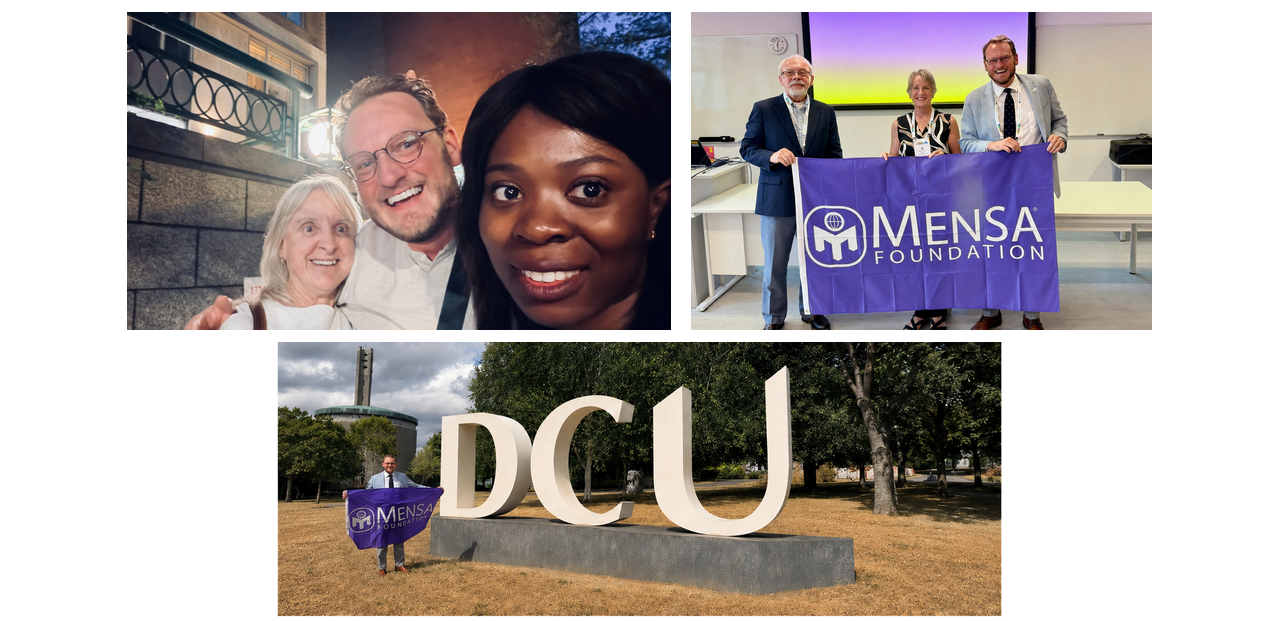
Before reaching Dublin, I had an extended layover in New York and spent time with Dr. Maggie Brown and Foundation Trustee Di Edwards. Maggie is one of the leading scholars in the study of gifted adults and a former Foundation Colloquium speaker. Our conversation returned to what this emerging field needs and how the Foundation might contribute. I carried that question with me to the 2026 European Council for High Ability Conference at Dublin City University, where I presented the Foundation’s Unmet Needs Study alongside Dr. Tracy Cross and Dr. Jennifer Cross.
Many presentations at the conference focused on gifted students and education, while only a handful focused on gifted adults. That is not a criticism of the conference. It reflects a field that has spent much of its history identifying gifted children and helping them succeed in school. Seeing those presentations alongside one another made the shift more visible. The study of gifted adults is gaining ground, but it remains a small part of the larger conversation.
After our presentation, I did something admittedly theatrical. I planted a Mensa Foundation flag on the university campus, an actual flag that I had made for the occasion. The flag marked how far the questions we began asking years ago had traveled, and it marked our commitment to keep asking them.
A Wider Role for the Foundation
The distinction between American Mensa and the Mensa Foundation is important to that work. American Mensa uses qualifying intelligence scores to determine membership. The Foundation is a separate public charity with its own board and a mission to unleash intelligence for the benefit of humanity. Our close connection to the Mensa community gives the Foundation a rare opportunity. We are connected to a large group of people brought together by high IQ, but our work does not have to end with the score that qualified them for membership. We can examine what that score does not tell us about the person’s life.
When I joined the Foundation in 2017, much of our work reflected the educational and psychometric paradigms that shaped the giftedness field. That work had value and still does. I also believed the Foundation could build on it by looking more fully at the people we hoped to serve. That belief began to take shape as a direction for the Foundation when I encountered Maggie’s research and began discussing it with then-Trustee Deborah Stone and Charlie Steinhice, now President Emeritus. Foundation Director Jill Beckham helped move those conversations into action, with support from other Foundation leaders who wanted to expand the organization’s purpose and reach.
From Conversation to Research
The first step was our 2022 Colloquium, Giftedness Across the Lifespan: A More Complete Picture. What emerged from that event was simple. Giftedness cannot be understood apart from the life in which it is experienced. The classroom was not a large enough frame, and neither was IQ alone. We carried that idea into two more Colloquia, exploring neurodiversity in 2023 and giftedness in the workplace in 2024. Those conversations kept returning us to a question we still could not fully answer. What do gifted adults themselves need?
Maggie helped us recognize that answering that question would require original research. The Foundation then commissioned its first original research study focused on gifted adults, the Unmet Needs Study of Highly Intelligent Adults. Dr. Tracy Cross and Dr. Jennifer Cross of William & Mary led the team that designed and conducted the research. More than 3,400 people participated. The most frequently reported unmet need was access to mental health professionals who understand high intelligence. The study also found that participants reporting more unmet needs reported lower levels of flourishing. High ability was no guarantee of well-being.
Because most participants were Mensa members, the study should be understood as a starting point rather than a complete portrait of gifted adults. Even so, it tells us something meaningful about the community that participated and gives us a reason to continue the research with a broader population. Presenting those findings in Dublin confirmed that these questions resonate beyond Mensa, even as the study of gifted adults remains a small part of the broader field.
What We Build Next
At the same time, our focus cannot simply shift from gifted children to gifted adults. That would replace one incomplete picture with another. “Giftedness is for life” requires us to understand the whole person throughout life, and educational support remains essential to that. The Foundation’s opportunity is not to own this emerging field but to help move it forward by connecting research with lived experience. The people living gifted lives must help shape the questions, not merely provide answers to ours.
As I said in Dublin, the Foundation stands on the shoulders of giants. The work of Maggie Brown, David Dai, Rianne van de Ven, and Ellen Fiedler helped us ask better questions. Noks Nauta and countless others have also shaped our thinking. We owe a profound debt to the thousands of people who trusted us with their experiences. Every finding in the Unmet Needs Study began with someone telling us something about their life, and understanding giftedness more fully requires us to continue listening to the people living it.
That is what planting the flag represented to me. It was not a declaration of ownership or a claim that we had arrived, but a commitment to help build an emerging field that considers giftedness throughout a person’s life. Planting the flag was the easy part. What matters now is what we build around it, and I invite anyone who shares this commitment to join us in shaping what comes next.






Comments (0)