


John Thompson, MSEd, CFRE, is Director of Development and Impact at the Mensa Foundation, working to broaden the understanding of intelligence and support gifted people across the lifespan.
Finding Landon
I want to tell you about Landon Ashworth and the film he made, Go On.
I found him the way many of us find things now — doomscrolling social media. The video my algorithm served up was a grown man playing both a witty, outspoken toddler in a cowboy hat and a calm, slightly overwhelmed father. It made me laugh, so I clicked the profile, @LandonAshworthDirects. There I found a strange, albeit brilliant range of content; sketches about golf, autism, marriage, astrophysics, and, of course, more Texas Tot. I also noticed, in one of the posts, that he was wearing a Mensa ball cap.
So I did what any respectable development director for the Mensa Foundation would do.
I slid into his DMs.
We have been in conversation ever since.
Getting to know Landon has been a treat. Despite the outgoing energy he brings to the screen, he is more reserved than he appears. He learned early that drawing attention came with a cost, and he has spent much of his life calibrating what to show and what to protect.
A Love Letter in Film
Landon wrote Go On in a single thirty-six-hour stretch in the weeks after his teenage cousin took his own life. When I asked what motivated the film, he told me, “It’s my love letter to my cousin.” In interviews, he has also called it an apology, for the things he was not able to share and the moments he would give anything to go back and change. Landon saw himself in the kid. Both were gifted minds trying to find their way in a world that did not quite make space for them.
Go On is a meditation on grief and what it means to let someone go. It is also, more quietly, a study of what it costs to be the kind of person other people come to for help. Landon has built much of his artistic work for the underdog, and Go On feels made for the disenfranchised, the hurting, and the lonely, in the hope that it might offer them some kind of lifeline.
Personally, I have carried grief longer than I knew how to name it. I know what it feels like to replay the past, to wonder what might have been different, and to work slowly toward forgiving yourself.
That is part of why Go On stayed with me, and why I am recommending it to you.
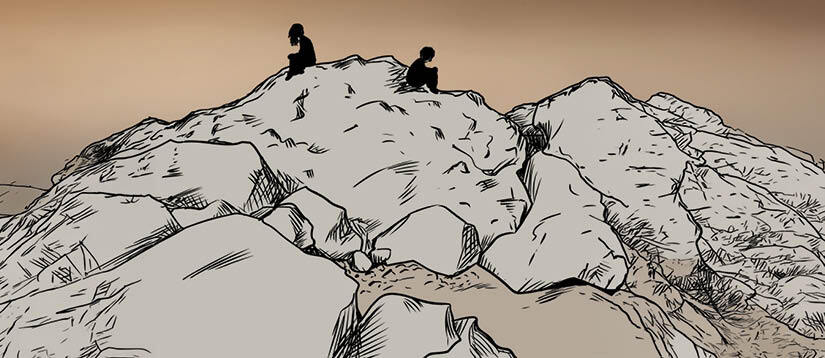
The film follows Jim, played by Landon, who has lived for hundreds, maybe thousands, of years on a fire-scarred mountain. He is alone. Visitors come and go, but Jim stays. During their visits, he helps each one understand their “why.” Again and again, he proves himself to be the helper, but never the helped.
Then he meets someone who will not leave. Someone who pushes past the surface questions and forces Jim to confront the pain he has spent a lifetime avoiding.
Jim reads as gifted or neurodivergent, though the film never turns identity into the plot. Landon made the choice not to name it directly. Instead, the film simply shows a life, with its patterns, sensitivities, rituals, defenses, and quiet brilliance, and trusts the viewer to recognize what is there.
That choice is one of the most respectful pieces of neurodivergent storytelling I have come across. It does not explain Jim. It lets him be.
About Landon
As a child from a cornfield in the middle of nowhere, Landon felt entirely isolated and faced relentless bullying. A childhood psychologist confirmed what his family already suspected that he processed emotions and the world differently than the other kids around him. Worried about his isolation, his parents put him into acting classes and community theater, hoping simply to get him out of the house and into a social setting.
But for Landon, the stage became something more. It became a laboratory. Acting gave him a structured framework for decoding human interaction. It taught him how to mirror social cues, how to read timing, and how to laugh when others laughed, even when he did not yet understand the joke. What began as a parental nudge to help him make friends became one of his primary tools for navigating a neurotypical world.
Back on the Mountain
Jim is perceptive, articulate, capable, and deeply alone. He has spent what feels like eternity helping other people understand their pain while refusing to face his own. When someone finally asks about the source of his grief, he resists. His pain, he suggests, is not the point.
That resistance felt familiar to me.
Not because Jim’s story is literal, but because the emotional pattern is. The person who can see clearly into everyone else’s struggle but cannot quite turn that same clarity toward himself. The helper who has become so practiced at helping others that he no longer knows how to ask to be helped. The brilliant mind that can explain almost anything except its own loneliness.
That is where Go On begins to speak directly to the work of the Mensa Foundation.
Why This Matters to Our Work
In 2024, the Foundation commissioned the largest study of unmet needs among highly intelligent individuals ever undertaken. Across 3,443 participants, the highest unmet need at every age was not academic. It was mental health and access to practitioners who actually understand high intelligence.
The second cluster of findings was about connection. Participants described a persistent sense of not belonging, of being capable in ways that often felt isolating rather than freeing. Many described looking for community and either not finding it or finding spaces where they still had to translate too much of themselves to be understood.
I have heard versions of that loneliness from gifted adults more times than I can count. From parents of twice-exceptional children doing the work of three specialists because no single specialist seems to exist. From people who have spent years searching for a therapist who can keep up with them.
There is a line in the film that has stayed with me more than any other. Jim, speaking about a cousin he lost, says the cousin told him, “I just want to matter.”
Landon has confirmed those words were not devised for the screen. His cousin told them to him. Go On is what Landon could not say then, offered now to anyone who has ever wondered the same thing.
Landon, thank you for making this. A love letter does not stop being a love letter because it arrives too late. Your cousin is present in it. So are the rest of us.
Go On is a reminder that none of us has to do it alone.
You can rent or buy Go On on Prime Video.






Comments (0)