
Colloquium 2026: Brain Health Across the Lifespan
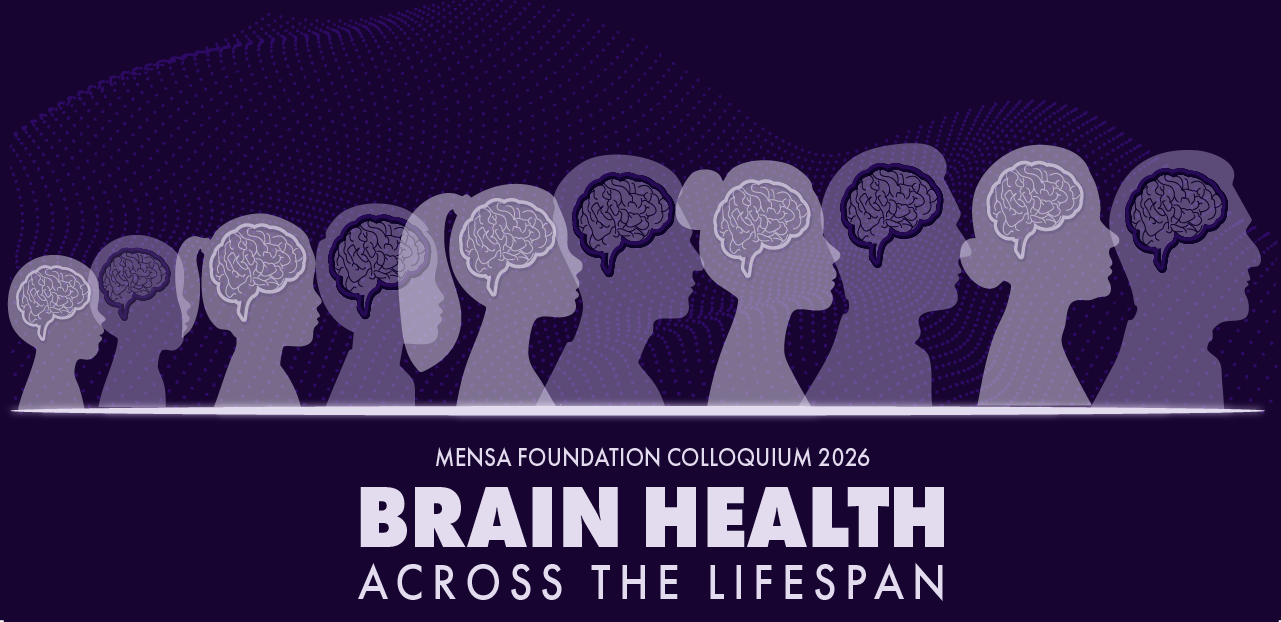
Brain Health Across the Lifespan is not just about one topic. It invites us to explore how we support the brain’s performance and resilience from early life through older adulthood. The answer is not found in one lever, but in the interplay between nourishment, sleep, mood and stress regulation, neuroplasticity, and whole-body systems that shape how the brain functions day to day.
That is the focus of the Mensa Foundation’s Colloquium on Brain Health Across the Lifespan, held June 30 in Fort Worth, Texas, at the Omni Hotel, from 1:00 to 5:30 PM. Registration is open here, and more details on each session topic and what to expect will be released soon. Below is a first look at the experts who will anchor the Colloquium.
Sandra Bond Chapman, PhD: Proactive BrainHealth, Cognitive Capacity, and Lifespan Performance
Dr. Sandra Bond Chapman is the founder of the Center for BrainHealth at The University of Texas at Dallas and a leading voice in proactive brain health, helping bring brain health into the same cultural and preventative-care conversation as heart health.
Her work focuses on measuring and strengthening cognitive capacity, including strategic attention, advanced reasoning, and innovative thinking, and translating research into interventions that support function and well-being across ages and contexts.
Grant H. Brenner, MD, DFAPA: Interventional Psychiatry and Emerging Technologies for Brain Health
Dr. Grant Brenner is a board-certified psychiatrist and psychoanalyst who works at the cutting edge of interventional psychiatry, with a focus on how targeted interventions can change brain networks in clinically meaningful ways. A key area of his work is Transcranial Magnetic Stimulation (TMS), an FDA-cleared treatment for major depressive disorder and obsessive-compulsive disorder, which he has used for years in real-world clinical practice.
In his session, expect an accessible, high-rigor look at how neuromodulation can support cognitive flexibility, helping people who understand issues intellectually finally make the emotional and behavioral connections needed to move forward. He will also explore the frontier question of whether neuromodulation may have a role not only in treatment, but in prevention and regenerative brain health, including what that could mean for adults who want to protect function as they age.
Dan Gartenberg, PhD: Sleep Science, Measurement, and Scalable Improvement
Dr. Dan Gartenberg is a sleep scientist (PhD in applied psychology) and the Founder and CEO of SleepSpace. His work centers on measuring and improving sleep using practical, user-friendly approaches that combine behavioral science, coaching, and technology.
He has published research on sleep measurement and enhancement and has worked on real-world performance applications, including vigilance assessment in military contexts.
Uma Naidoo, MD: Nutritional Psychiatry and Food for Mood
Dr. Uma Naidoo is a Harvard-trained psychiatrist and a professional chef whose work sits at the intersection of mental health and nutrition, an approach often described as nutritional psychiatry. She founded and directs the first hospital-based Nutritional Psychiatry Service in the U.S. and serves in leadership roles at Massachusetts General Hospital and Harvard Medical School.
Her public-facing work translates brain-and-gut science into practical strategies, showing how everyday food choices can support mood, focus, memory, sleep, and stress resilience, and how nutrition can complement clinical care.
Srini Pillay, MD: Consciousness, Mindset, and Whole-Body Healthspan
Dr. Srini Pillay’s session will push the Colloquium into a bigger question: what if brain health cannot be understood through a brain-only, linear model? Drawing on neuroscience, immunology, developmental biology, and complexity science, he will explore how consciousness, mindset, and biological health may be deeply intertwined.
His talk reframes healthspan as an emergent property of coordinated intelligence across the body. He will also examine how mindset may shape immune and inflammatory pathways, and why concepts such as fractality, cellular agency, and subjective experience (qualia) may be essential for understanding chronic disease and resilience.
If brain health matters to you, this Colloquium is for you. Join us June 30 in Fort Worth at the Omni Hotel, from 1:00 to 5:30 PM, for a full afternoon of ideas, insight, and practical takeaways.








Comments (0)