



John Thompson is Director of Development and Impact at the Mensa Foundation, where he leads development and educational efforts to expand society’s understanding of intelligence and support the lived experience of gifted and neurodivergent individuals.
Rethinking Giftedness: From Ability to Lived Experience
What happens when high ability is easy for others to see but difficult to live inside?
Giftedness is often discussed as cognitive strength: fast thinking, deep analysis, strong pattern recognition, intellectual range. But for many gifted adults, the lived experience is far more complex. It can include intensity, chronic mismatch, masking, over-functioning, and a persistent sense of being misunderstood even in environments where they appear to thrive.
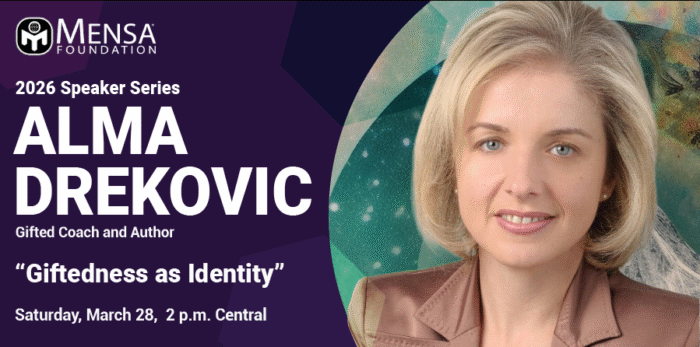
That is part of what Alma Dreković will explore in the Mensa Foundation’s upcoming virtual Speaker Series session, Giftedness, Identity, and Brain Health.
This session will take place on March 28, 2026, at 2pm central. Register here.
Alma is a coach, consultant, and author whose work focuses on gifted and highly gifted adults, particularly those whose professional competence may be obvious while their internal experience remains largely unseen. Ahead of her March session, we spoke with her about giftedness as lived experience, why identity matters, and what “brain health” means in this context.
More Than Ability: Alma’s Focus on the Lived Experience of Gifted Adults
For people encountering her work for the first time, Alma describes her approach as both holistic and grounded in real-life complexity.
Her work is international, and she specializes in supporting gifted and highly gifted adults, including executives, academics, and creatives. Many of the people she works with have exceptional capacity, but their daily lives are shaped by intensity, complexity, and chronic mismatch. Her approach combines depth-oriented coaching with structure and clarity, with the goal of helping clients move toward lives and careers that feel more coherent and psychologically sustainable.
She also brings an intercultural lens to this work, paying close attention to the ways thinking, emotion, regulation, relationships, values, and context interact.
That emphasis on complexity did not come from theory alone.
Why Giftedness Became Central to Alma’s Work
Alma says her focus on gifted adults is deeply biographically informed. About 15 years ago, during a psychoanalytic process, she was confronted with her own giftedness. That realization gave her a new framework for understanding longstanding questions about identity, belonging, perception, and intensity.
What began as personal insight became an intellectual and professional commitment. Over time, she found herself working with highly capable adults who were functioning well on the surface but privately struggling with stress, masking, and a lack of fit. Again and again, the deeper issue was not simply performance. It was coherence.
That, in many ways, became the center of her work.
Q: When you say “high giftedness,” what do you mean by that term?
Alma: “High giftedness” refers to the upper end of the ability distribution, often discussed around an IQ of 145+, though I am cautious about reducing a person to a score. What matters most is the lived experience associated with very high cognitive ability: rapid pattern recognition, deep processing, systems thinking, and often heightened intensity.
Definitions vary, and measurement has limits. Some people may function in that range without having adequate language for their experience, or without ever feeling accurately mirrored, even within gifted communities. That gap can reinforce chronic self-editing and mismatch.
To explore these questions more precisely, I co-founded the interdisciplinary Highly Gifted Expert Group with Noks Nauta and several Dutch colleagues. We examine what may be qualitatively different in the 145+ range and what is shared with the broader gifted range. A qualitative shift seems plausible based on recurring observations, but it needs to be investigated carefully and responsibly.
Why Identity Matters So Much
One of the most useful ideas in Alma’s framework is that giftedness is not just something a person has. For many adults, it functions more like a lens through which experience is organized.
That shift matters.
When giftedness is treated only as intellectual ability, it is easy to miss how it affects self-trust, belonging, emotional life, work patterns, and relationships. In Alma’s experience, gifted adults rarely show up asking to talk about “giftedness” directly. More often, they come in with questions about burnout, chronic stress, underachievement, shutdown, loneliness, self-doubt, or the feeling that something is off despite strong capability.
Q: What first prompted you to explore the relationship between giftedness and identity, rather than treating giftedness as only a cognitive trait?
Alma: In my coaching practice, and biographically as well, I kept noticing that gifted adults rarely arrive with “giftedness” as the headline. They come with concerns around identity, self-trust, and belonging, often alongside recurring patterns such as burnout or boreout, chronic stress, somatic complaints, underachievement, shutdown, or the persistent sense that something is off despite high capability.
Many have spent years translating themselves for others, moderating their intensity, or performing competence while feeling unseen.
Over time, it became clear to me that giftedness often functions less like a trait one has and more like a lens through which experience is organized: how one perceives, thinks, feels, relates, and makes meaning. If that lens remains unnamed or fragmented, people often compensate through masking and over-functioning. That can increase chronic stress and erode coherence. When it is recognized and integrated, it often becomes a turning point.
The Questions Gifted Adults Often Carry
Across Alma’s work, certain questions tend to repeat. They are not always framed in the same language, but they often orbit the same core concerns:
How do I stop shrinking myself?
Why do I feel unseen even in high-achievement environments?
How do I know who I am apart from performance?
What would it look like to belong without constant translation?
Those questions point to a deeper task: moving from chronic adaptation toward a more coherent identity.
Q: For someone who suspects giftedness might be relevant to their life, what signs or patterns often prompt them to explore it more seriously?
Alma: Giftedness often becomes relevant not because of ability alone, but because certain patterns keep repeating across contexts.
Common prompts include intensity, unusual speed of thought, a chronic lack of fit despite high competence, a lifelong sense of feeling misunderstood, and a persistent sense of being somehow different. Many also experience mental overactivity that makes it difficult to switch off, as well as oscillation between exceptional output and periods of exhaustion or shutdown.
Another recurring pattern is a strong need for depth, ethics, and coherence that is repeatedly frustrated in superficial or ill-fitting environments. When these patterns persist, people often realize that what they are dealing with is not just stress, but something more fundamental about how they experience and process the world.
From Identity to Brain Health
This is where Alma’s upcoming session becomes especially compelling.
Too often, brain health is discussed in narrow or purely biomedical terms. Alma uses it more practically. In her framing, brain health is about the long-term sustainability of cognitive and emotional life: attention, regulation, recovery, resilience, and the ability to function well under load.
That framing may resonate with many gifted adults, especially those who have spent years operating in states of internal overdrive while appearing outwardly competent.
Q: Your session is titled Giftedness, Identity, and Brain Health. What does “brain health” mean in the context of your talk?
Alma: In the context of my talk, brain health is a practical, human concept. It is about functioning and living well. I use it to describe the long-term sustainability of cognitive and emotional life: attention, regulation, recovery, resilience, and the capacity to thrive under load.
Many gifted adults carry invisible strain, which over time can show up in sleep, mood, cognition, and overall wellbeing.
Because my session links brain health with identity, it also helps to clarify what I mean by identity. Identity is a coherent self-understanding across contexts, shaped by dimensions such as culture, language, biography, values, relationships, and social location. Giftedness is not the totality of a person, but for many it is identity-relevant. It shapes how one thinks, perceives, feels, and makes meaning. When consciously integrated, it can reduce avoidable strain and support more sustainable life choices.
Why Conceptual Clarity Matters
Another theme Alma addresses carefully is the growing tendency to collapse giftedness and neurodiversity into one broad category. She understands why people do it. For some, neurodiversity feels like a more socially accepted way to name difference. But she also argues that the overlap in lived experience should not erase important distinctions.
That matters not just in theory but in support.
Q: When people connect giftedness and neurodiversity, what are they usually trying to name?
Alma: They are often trying to name a shared lived experience: feeling wired differently, processing the world intensely, and struggling to thrive in standardized environments. Neurodiversity emerged as an inclusion-oriented framework from autism self-advocacy and is now widely used in public discourse. Giftedness is a different concept, even when lived experience overlaps.
Some gifted adults prefer a neurodiversity framing because it can feel more socially acceptable and less likely to trigger stereotypes of elitism. In that sense, it can feel safer. But it becomes problematic if it blurs important conceptual and practical distinctions.
In my work, I keep the concepts clear. Giftedness and neurodiversity are not synonymous. Neurodiversity functions primarily as a social and ethical language of inclusion, not as a clinical diagnostic term. That difference matters once we move from discourse to support.
Q: Once that conversation moves from theory to support, what distinctions matter most?
Alma: The most important point is that support must be individualized. Giftedness is a highly heterogeneous field, and in practice it always intersects with personality, biography, and context. The guiding question is not “Which label fits?” but “What does this person need, and what kind of support is appropriate?”
A second distinction is professional scope. Coaching is appropriate for psychologically stable clients who want to strengthen clarity, agency, fit, and sustainable performance. If there is a clinical need, such as significant depression, acute crisis, severe anxiety, trauma-related symptoms, or anything requiring diagnosis and treatment, then medical or psychotherapeutic care is the appropriate path.
Finally, it is important to recognize complex constellations without forcing them into a single label. People often present with multiple layers: giftedness, stress load, life history, and relational dynamics. Those constellations deserve accurate understanding and the right kind of support.
What Attendees Can Expect in the Session
In her March Speaker Series talk, Alma will connect three themes that are often discussed separately but belong together:
giftedness as lived experience, identity and belonging, and brain health as long-term sustainability.
Attendees can expect a nuanced exploration of how chronic mismatch, internal overdrive, masking, and lack of fit shape the lives of many gifted adults, and what can change when giftedness is consciously integrated into identity. The session will also examine how regulation, boundaries, and better-fit contexts can reduce avoidable strain and support more sustainable wellbeing and performance.
In other words, this is not just a talk about giftedness as potential. It is a conversation about what it takes to live well.
Join us on March 28, 2026 at 2pm central for the Mensa Foundation Speaker Series with Alma Dreković: Giftedness, Identity, and Brain Health. Register here.
If you are interested in giftedness beyond IQ, identity beyond performance, or brain health beyond simplistic definitions, this session offers a thoughtful and timely conversation.







Comments (0)