
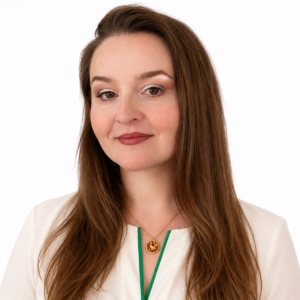
Angela C. Meyers, Ph.D. is a researcher, author, and speaker whose work focuses on polymathy and lifelong learning. Her doctoral research explored modern polymaths and how people develop knowledge across multiple domains.
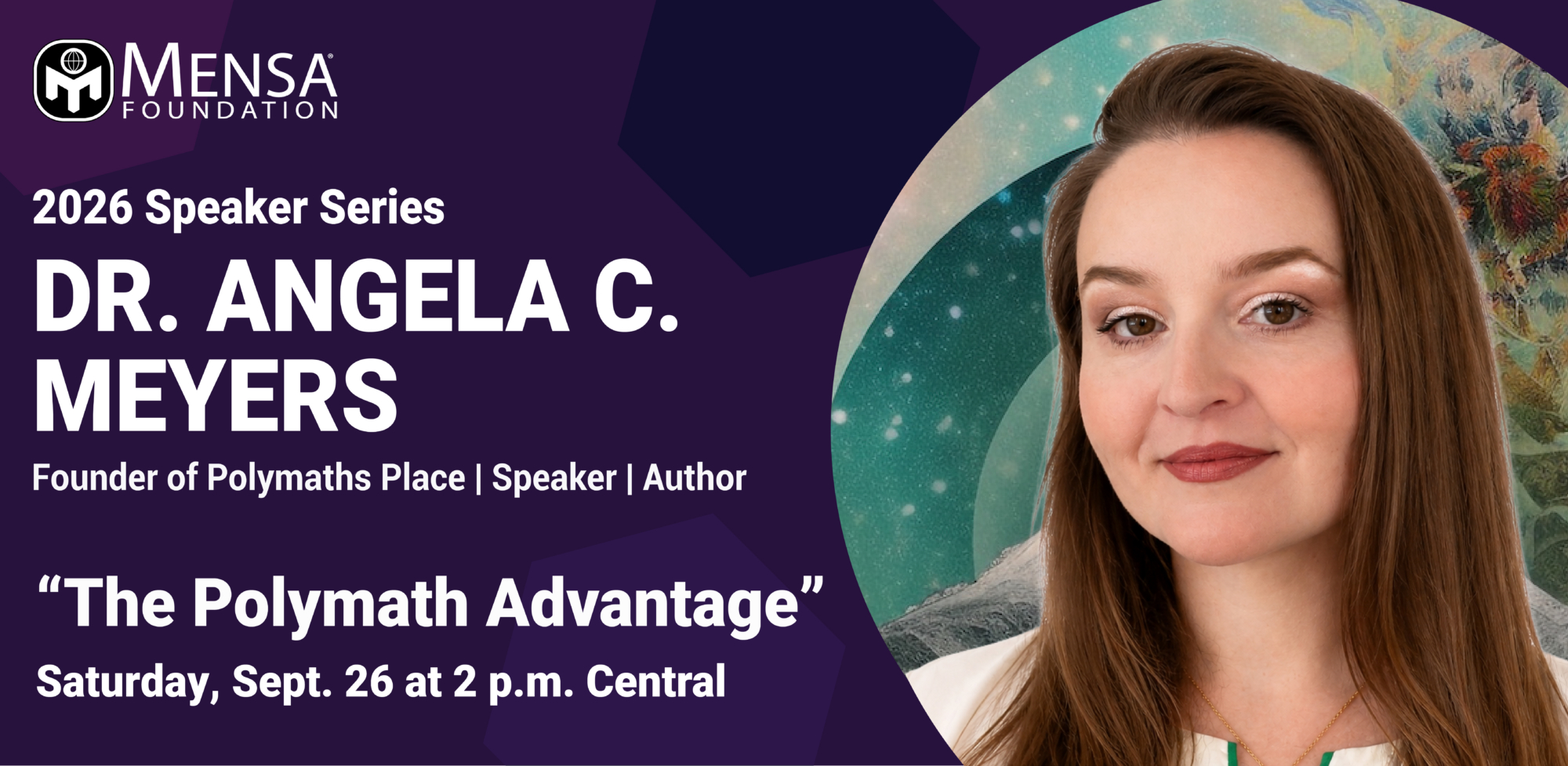
What happens when the problems we face no longer fit neatly within a single discipline? Ahead of her Sept. 26 Mensa Foundation Speaker Series presentation, The Polymath Advantage, Dr. Angela C. Meyers explores polymathy and why the ability to learn and connect knowledge across domains may matter more than ever.
One of the things I’ve been most excited about since joining Mensa as a member is the opportunity to be in conversation with other people who genuinely love learning.
Not learning as credential-collecting or résumé-padding, but learning as an ongoing practice of self-development. Learning as curiosity. Learning as a way of upgrading how we understand the world and our place in it.
That love of learning is what first drew me, more than a decade ago, to the study of polymathy, or “many learnings.”
Polymathy Studies: An Emerging Field
Many people are surprised to learn that there is now an emerging field in academia called polymathy studies. It is an attempt to better understand humans who are particularly good at learning across domains, not superficially, but deeply and integratively.
Polymathy studies asks questions such as:
- How do some people develop expertise in multiple domains?
- What cognitive habits support learning broadly and deeply over a lifetime?
- How do integrative thinkers navigate complexity differently than narrow specialists?
- What happens when these capacities are applied to real-world problems?
I wrote the first doctoral dissertation focused specifically on polymathy as a human phenomenon, completed in 2018, and later supervised the second. Since then, I’ve continued writing, speaking, creating programs to support organizations, and building an online community centered on these ideas.
Not because polymathy is about being exceptional, but because it reflects something profoundly human: our capacity to grow through learning.
Learning as Mental Software Upgrades
I’ve always loved learning. For me, learning has never been a phase of life that ends with formal schooling. It’s how we continually refine our mental models, our assumptions, and our understanding.
In a sense, learning is how we upgrade our mental software.
We don’t do it once. We do it over and over again, across a lifetime and across domains. That’s what polymathy really is: a commitment to lifelong and lifewide learning.
And this matters because learning is not only how we make ourselves better as individuals. It’s how we make everything better.
Better systems. Better decisions. Better futures.
Intelligence Alone Is Not Enough
Intelligence fixes a great deal. But intelligence by itself is not sufficient.
History makes this painfully clear.
Intelligence without ethics can be used for harm. Intelligence without perspective can become dangerously narrow. Intelligence without humility can blind us to consequences we didn’t intend.
What we need, especially now, is intelligence mixed with ethics, systems awareness, care for our fellow humans, and a willingness to keep learning when old models no longer work.
The Limits of the Age of Specialization
For much of the modern era, we were encouraged to specialize. To pick one thing. To stay in our lane. To operate within silos.
That approach delivered real benefits. It helped build modern science, medicine, and industry. But it also came with costs.
Specialization sometimes turned curious humans into narrow functions. In extreme cases, it caged minds that wanted to explore, connect, and integrate.
Today, we’re seeing the limits of that model.
Many narrowly specialized roles are now at risk of automation. At the same time, the problems we face, including climate instability, financial fragility, educational breakdowns, and public health challenges, are deeply interconnected.
What happens in one part of the world affects others. Air pollution doesn’t respect borders. Supply chains don’t stop at national lines. Information moves globally in seconds.
We have organized ourselves into 195 governments, each optimizing locally in a world that behaves systemically. That mismatch is beginning to show.
Why Polymathy Matters Now
If you see the current moment as a metacrisis, the convergence of multiple systemic failures, then it becomes clear that many of our challenges stem from not seeing the larger picture.
From optimizing parts without understanding wholes. From solving problems in isolation without accounting for downstream effects.
Polymathic thinking is not a silver bullet. But it is uniquely suited to this moment because it emphasizes holistic understanding, cross-domain learning, adaptability as conditions change, and continuous revision of mental models.
In the age of artificial intelligence, these capacities become even more important. As machines take over narrow, repeatable tasks, the human advantage shifts toward integration, judgment, and ethical sense-making.
Looking Ahead, Together
On September 26, I’ll be giving a presentation for fellow Mensa members on polymathy and its relevance in our current and future world. It’s a conversation I’ve been engaged in for over a decade, and one I’m deeply grateful to share within a community that values intelligence and learning.
My hope is not only to help individuals develop their own polymathic capacities, but to explore what might be possible if we began to cultivate collective intelligence more intentionally.
To co-learn. To co-think. To apply our intelligence with care, humility, and purpose.
I’m genuinely excited to be part of Mensa and to learn alongside others who are curious, capable, and motivated to use their minds not just impressively, but wisely.
In future posts, I’ll share more about how we might do that together.
Join the Mensa Foundation Speaker Series
Hear more from Dr. Meyers on September 26 at 2 p.m. Central during the Mensa Foundation Speaker Series, where she will explore polymathy and what it can offer individuals navigating an increasingly complex world.





Comments (0)